Category: Uncategorised

  • Public consultation opportunities: April-May 2026 | Consultations publiques : avril-mai 2026

    (version anglaise)

    1. The next EU Action Plan for gender equality and women’s empowerment in EU external action (GAP IV) public consultation (deadline 30 April

    The EU is currently developing the next strategy for promotion of gender equality in its external action: the Gender Action Plan IV. This information note presents the process to define these priorities, as well as the opportunities for civil society organisations to take part in these discussions, make their voices heard and push for the adoption of a strong and ambitious political document to follow up the GAP III.

    The European Commission has launched a public consultation on GAP IV, with the deadline for submitting written feedback to the call for evidence on Thursday, 30 April 2026.

    Contributions can be made via the online system by both:

    • Drafting a 4000-character text and
    • (ii) uploading a file (such as a report or position paper in PDF format, max 5MB).

    CONCORD, a member of the Africa-Europe Civil Society Platform (CSEP), submitted input to the European Commission consultation (call for evidence) on the next EU Action Plan for gender equality and women’s empowerment in EU external action (GAP IV).

    We are encouraging other civil society organisations from Africa and Europe to submit their views so that we have a stronger impact together. We have developed a short guide in three languages to facilitate submissions by civil society:

    Further details about CONCORD’s position on GAP IV, are outline in its 2025 position paper.


    2. The European Investment Bank (EIB) update of their Complaints Mechanism policy (deadline 19 May

    CONCORD, a member of the Africa-Europe Civil Society Platform (CSEP), is working in a collation with several organisations (see list below) to prepare a joint submission to the public consultation on the draft new policy of the EIB Group Complaints Mechanism.

    We are sharing a short guide prepared by CEE Bankwatch Network and CONCORD outlining the context of the consultation, key dates, how to participate, and a summary analysis of the updated draft policy with ideas and recommendations for improvement prepared by Accountability Counsel. With the guide we hope to raise awareness on the public consultation process and maximise the participation of allies, colleagues, and partners to submit a response to the consultation. We want to make the most of this opportunity to strengthen the draft EIB Global Complaints Mechanism Policy and ensure that it addresses the needs of those who use the mechanism.

    The guide for CSO contributions can be consulted online  in EnglishFrench and Spanish.

    Asia Indigenous Peoples Network on Extractive Industries and Energy (AIPNEE)

    Accountability Counsel

    CEE Bankwatch Network

    CONCORD Europe

    Counterbalance

    Inclusive Development

    Jamaa Resource Initiatives (Kenya)

    Re-course

    (version française)

    1. Consultation publique sur le prochain plan d’action de l’UE pour l’égalité entre les femmes et les hommes et l’autonomisation des femmes dans l’action extérieure de l’UE (GAP IV) (date limite : 30 avril)


    L’UE élabore actuellement la prochaine stratégie visant à promouvoir l’égalité entre les femmes et les hommes dans son action extérieure : le quatrième plan d’action pour l’égalité entre les femmes et les hommes (GAP IV). Cette note d’information présente le processus de définition de ces priorités, ainsi que les possibilités offertes aux organisations de la société civile de participer à ces discussions, de faire entendre leur voix et de plaider en faveur de l’adoption d’un document politique fort et ambitieux pour donner suite au GAP III.


    La Commission européenne a lancé une consultation publique sur le GAP IV, la date limite pour soumettre des commentaires écrits à l’appel à contributions étant fixée au jeudi 30 avril 2026.
    Les contributions peuvent être soumises via le système en ligne de deux manières :
    (i) en rédigeant un texte de 4 000 caractères et
    (ii) en téléchargeant un fichier (tel qu’un rapport ou une prise de position au format PDF, 5 Mo maximum).

    CONCORD, membre de la Plateforme de la société civile Afrique-Europe (CSEP), a soumis ses contributions à la consultation de la Commission européenne (appel à témoignages) sur le prochain plan d’action de l’UE pour l’égalité entre les femmes et les hommes et l’autonomisation des femmes dans l’action extérieure de l’UE (GAP IV).

    Nous encourageons les autres organisations de la société civile d’Afrique et d’Europe à soumettre leurs points de vue afin que nous ayons ensemble un impact plus fort. La consultation est ouverte jusqu’au 30 avril et nous avons élaboré un petit guide en trois langues pour faciliter les contributions de la société civile :

    De plus amples détails sur la position de CONCORD concernant le GAP IV sont présentés dans son document de position 2025.


    2. Mise à jour de la politique relative au mécanisme de traitement des plaintes de la Banque européenne d’investissement (BEI) (date limite : 19 mai)

    CONCORD, membre de la Plateforme de la société civile Afrique-Europe (CSEP), collabore avec plusieurs organisations (voir la liste ci-dessous) afin de préparer une contribution commune à la consultation publique sur le projet de nouvelle politique relative au mécanisme de traitement des plaintes du Groupe BEI.

    Nous partageons un petit guide préparé par le CEE Bankwatch Network et CONCORD, qui présente le contexte de la consultation, les dates clés, les modalités de participation, ainsi qu’une analyse sommaire du projet de politique actualisé, accompagnée d’idées et de recommandations d’amélioration préparées par Accountability Counsel. Grâce à ce guide, nous espérons sensibiliser au processus de consultation publique et maximiser la participation de nos alliés, collègues et partenaires afin qu’ils soumettent une réponse à la consultation. Nous souhaitons tirer le meilleur parti de cette opportunité pour renforcer le projet de politique relative au mécanisme mondial de traitement des plaintes de la BEI et veiller à ce qu’il réponde aux besoins des personnes qui utilisent ce mécanisme.

    Le guide sur les contributions des OSC peut être consulté en ligne en anglais, en français et en espagnol.

    Réseau des peuples autochtones d’Asie sur les industries extractives et l’énergie (AIPNEE)

    Accountability Counsel

    Réseau CEE Bankwatch

    CONCORD Europe

    Counterbalance

    Inclusive Development

    Jamaa Resource Initiatives (Kenya)

    Re-course
  • Civil Society speaks @ the 2025 Luanda Summit

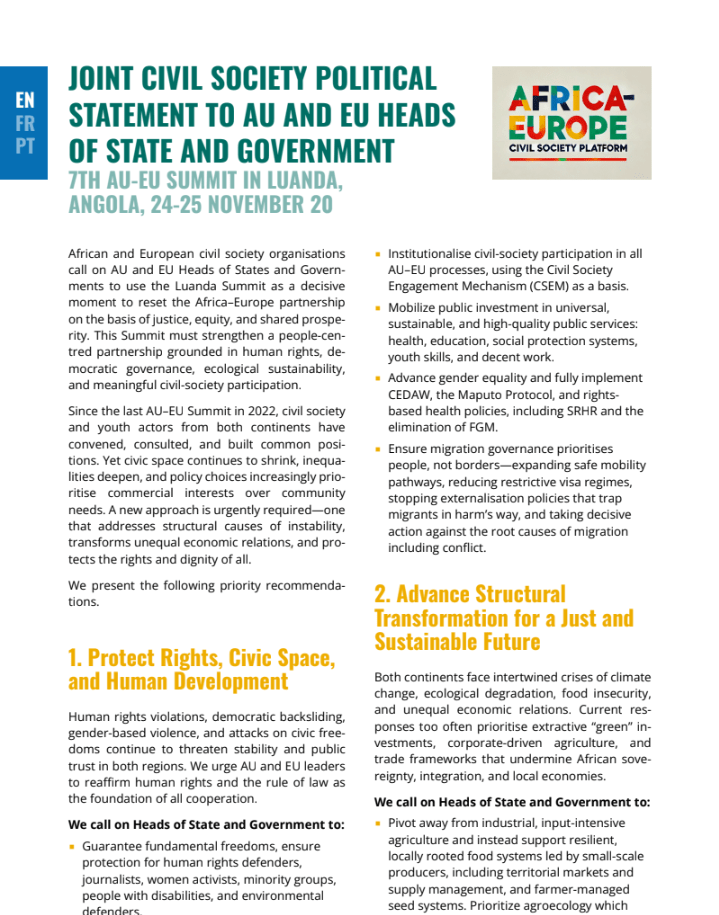
    Joint Civil Society Statement to the 7th AU-EU Summit

    Prepared by the Africa-Europe Civil Society Platform (CSEP), based on broad consultation with African and European civil society and youth organisations during thematic working group meetings and a series of online consultations involving over 120 participants in October and November 2025.

    The statement has been endorsed by the Interim Steering Committee of the CSEP and is open for signature through 21 December 2025. SIGN ON 🖊️

    English text // Texte français // Texto em português

    Joint Civil Society Recommendations for the 7th AU-EU Summit

    A more detailed list of the recommendations that were elaborated by the CSEP based on inputs received during the consultation process.

    Specific positions and recommendations drafted by the thematic working groups and other constituencies active in the CSEP

    These positions are reflected in the overall CSEP statement and recommendations but are more granular and detailed according to the areas of expertise and interest.

    • AU-EU Civil Society Parallel Summit Statement, Luanda, 25 NOVEMBER 2025
    • “For the Well-Being of All: Embracing a New Foundational Paradigm on the 25th Anniversary of the AU–EU Partnership” statement by Bahá’í International Community (BIC) EN
    • Joint Statement of Catholic organisations ahead of the AU-EU Summit ENPTFR
    • Unified civil society voice on key climate and energy concerns ENsign on
    • “Education at the Heart of the AU-EU Partnership” An open letter by civil society organisations EN
    • A DEFINING MOMENT FOR GLOBAL HEALTH: ACCELERATING HEALTH EQUITY UNDER THE AU-EU PARTNERSHIP Civil Society Recommendations ahead of the 7th AU-EU Summit EN
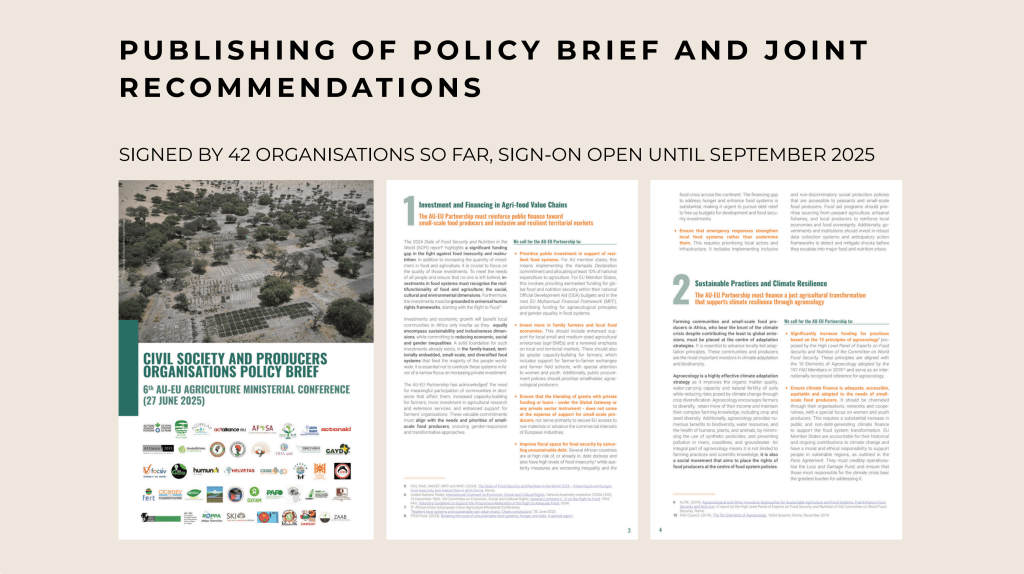
    • CIVIL SOCIETY AND PRODUCERS ORGANISATIONS RECOMMENDATIONS TO THE 6th AU-EU AGRICULTURE MINISTERIAL CONFERENCE, ROME, 27 JUNE 2025 ENFR

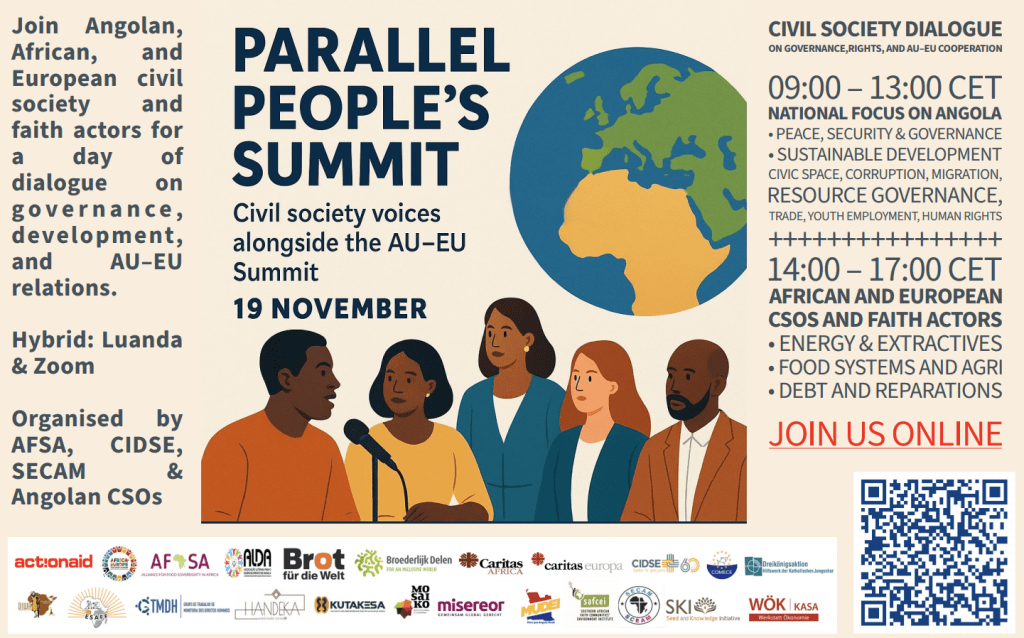
    Parallel People’s Summit – 19 November

    The Africa-Europe Civil Society Engagement Platform is collaborating with Faith actors from Europe and Africa and Angolan CSOs in organizing a Parallel Peoples’ Summit on 19th Nov.

    Follow the exchanges online with the zoom link in the flyer above.
    AUEU2025

  • Transformative change at the heart of CSEP side-event during the 6th AU-EU Agriculture Ministerial Conference [EN]

    27 June 2025—Rome, Italy 

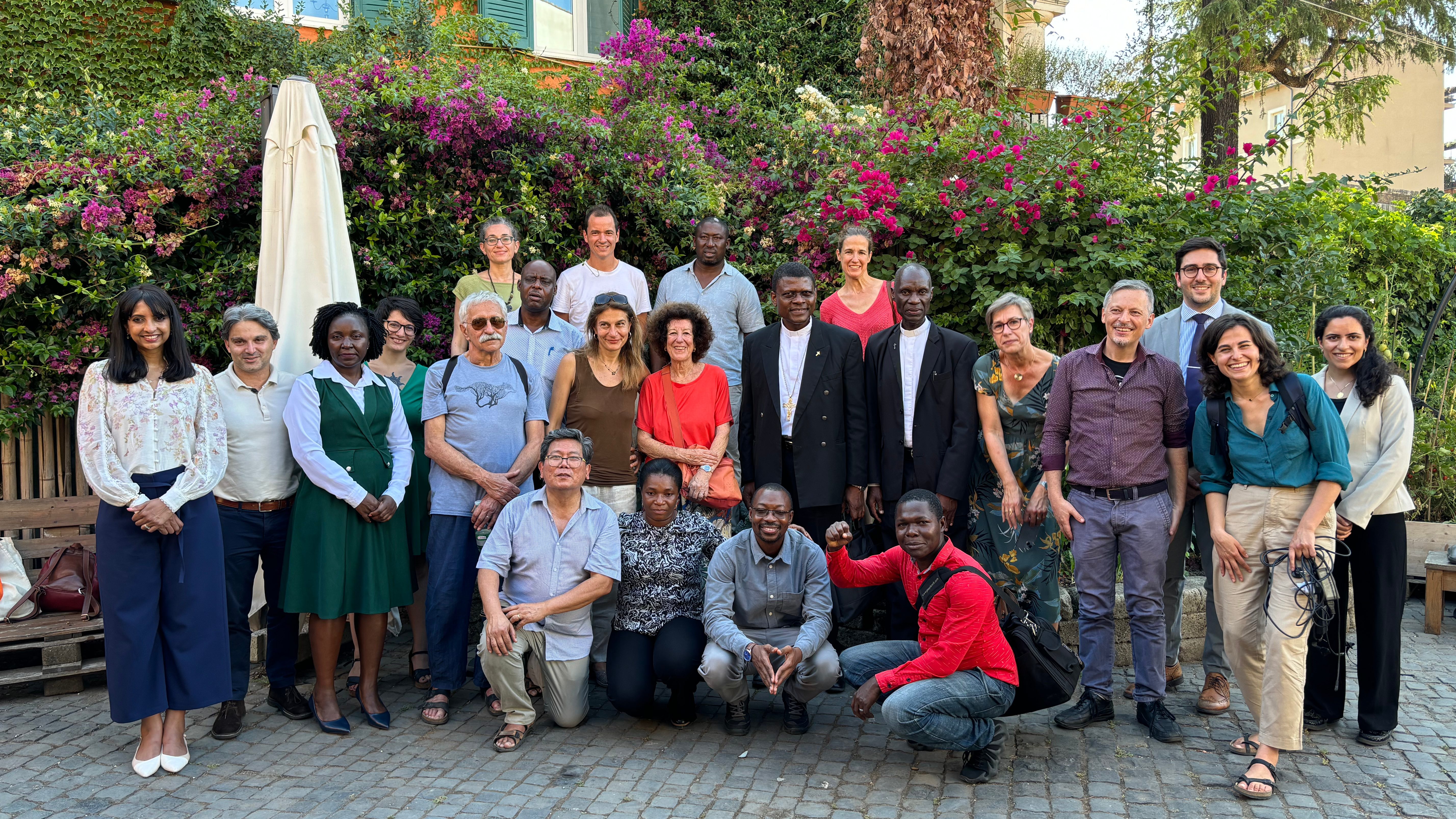
    The Civil Society Engagement Platform’s (CSEP) Food Systems Working Group participated in discussions on just, sustainable, and resilient agri-food systems at the 6th African Union (AU) – European Union (EU) Joint Agriculture Ministerial Conference.

    The conference brought together African and European ministers and ambassadors of agriculture—representing almost half the world’s agriculture ministers, and almost two billion people—as well as AU and EU commissioners, farmers organisations and United Nations (UN) agencies, to strengthen the collaboration between the two Unions, and address current challenges facing both continents’ agri-food systems.

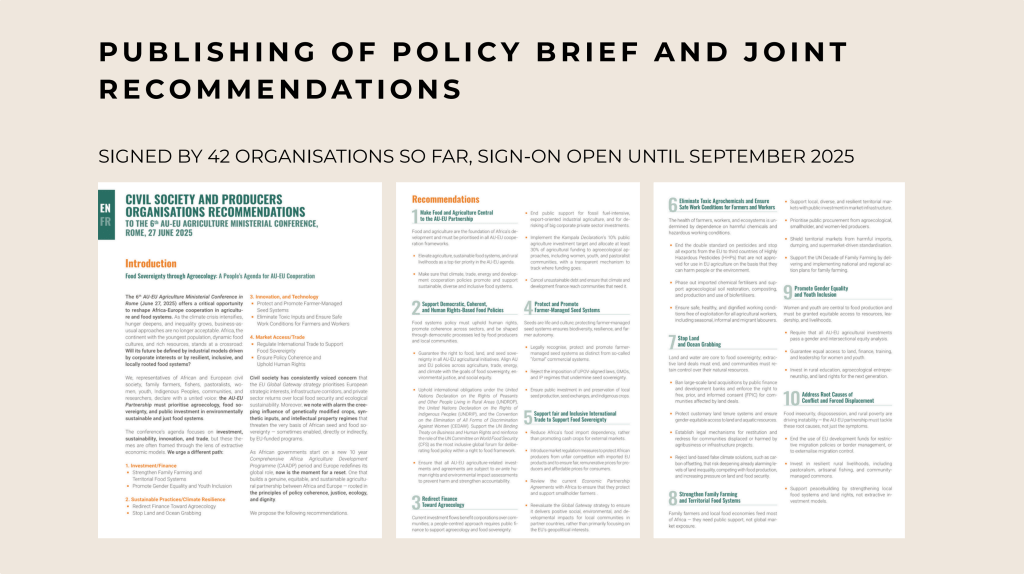
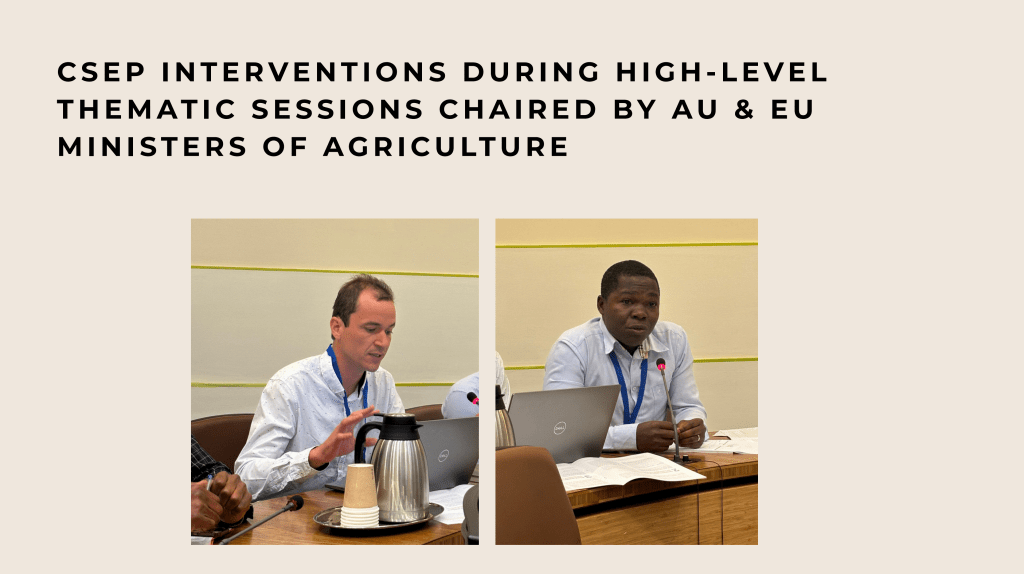
    The CSEP engaged in several bilateral conversations with AU and EU ministers and commission staff, and national farmer representatives, to elaborate further on its policy brief and recommendations, published in light of the Ministerial Conference. 

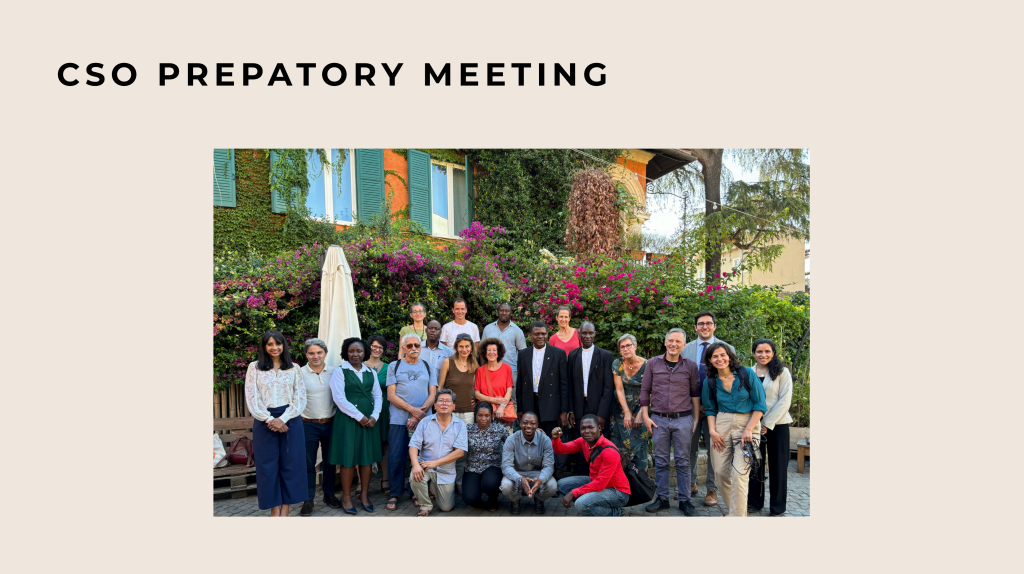
    The platform had already been meeting for several months, ahead of the conference, to further develop its messaging and explore how effective policy reforms can be guided by a commitment to the well-being and prosperity of both continents—and, indeed, all of humanity.

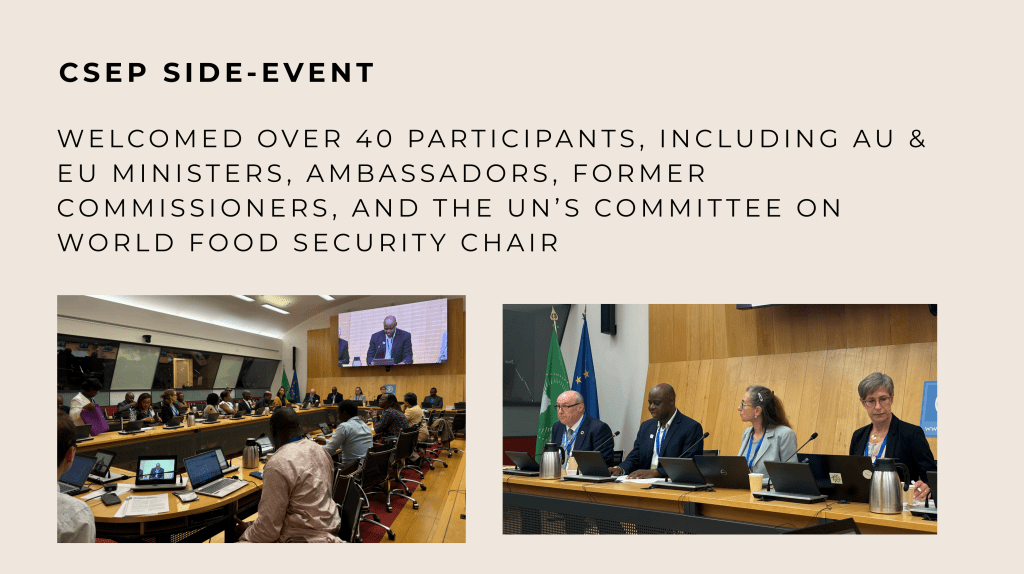
    The CSEP organised a side-event at the conference which welcomed over 40 participants, including ministers, ambassadors, and former commissioners. Opening the side-event, Advocacy Lead from Alliance2015, Ms. Adriana Opromolla, said “Today is an opportunity to reflect on how the vision of the AU and the EU can converge in ways that promote transformation, guided by the realities of farmers and communities.”

    The Just Economy Program and Policy Manager for Oxfam in West Africa, Mr. Francis Agbere, added that the AU-EU Partnership should “adopt policies that reduce inequality, enhance climate and environmental justice, and promote good governance and fairer trade rules, so that international trade can also benefit smallholder farmers.”

    The Belgian Permanent Representative to the UN Rome-based agencies, Mr. Lieven De la Marche, shared that “agriculture is a transversal issue and no single actor can solve the challenges alone.” 

    In elaborating on the role of governments in generating consensus and a unified vision for national plans related to the agri-food system, the Irish Agriculture Attaché to the UN Rome-based agencies, Mr. Peter Cleary, said, “it’s necessary to have buy-in from all involved.” 

    “This is not a discussion between North and South. It is about human dignity. The future of the African food system must be in African hands.” added Musa Sowe, Vice President of ROPPA and head delegation of the Pan-African Farmers Organization (PAFO) to the ministerial. 

    “We call for the full implementation of the Kampala Declaration, with at least 30% of the agricultural budget reserved for agro-ecological practices, with particular attention to women, young people and pastoralists” said Hakim Baliraine, chairperson of AFSA and board member of ESAFF. 

    The side event elaborated on food sovereignty as not merely a technical issue but a matter of justice, identity, and autonomy. It called for decisions on financial resources and international cooperation to be guided by broader values and principles that allow for local communities to break free from harmful patterns of dependence.

    How small-scale farmers, women and young people can become co-owners or co-creators of a sustainable food system, rather than being invited to the table as guests of an existing system was also explored.

    During her keynote speech, Ms. Nosipho Nausca-Jean Jezile, Chair of the Committee on World Food Security (CFS) shared that the crises facing Africa are visible symptoms of a derailed and dysfunctional global system, and thus called for the dedication of resources towards the fight against hunger and extreme poverty.

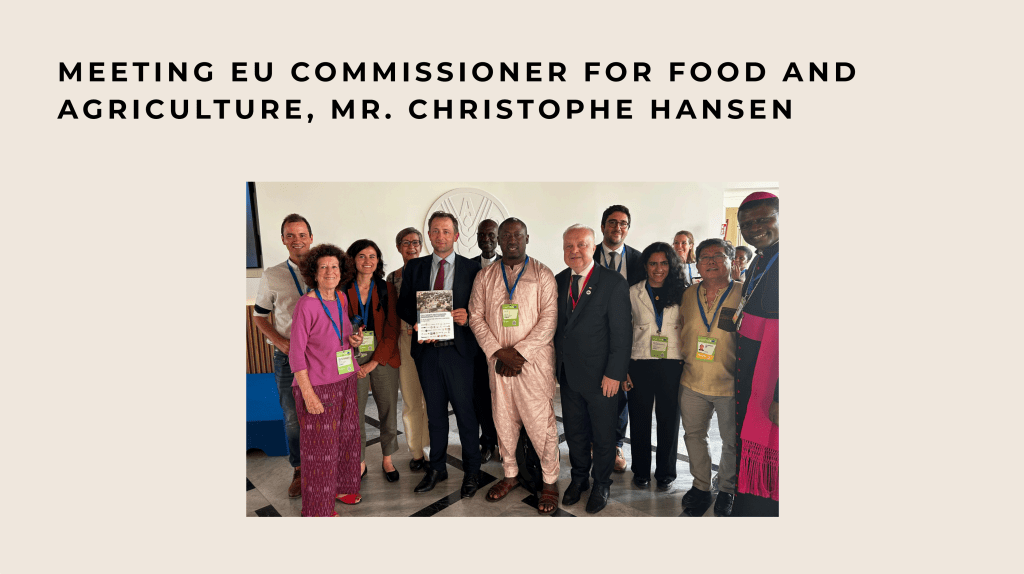
    The CSEP also shared its key messages with the EU’s Commissioner for Agriculture and Food, Mr. Christophe Hansen

    Sign-on to the CSEP’s messages is open until September 2025.


    Le changement transformateur au cœur de l’événement parallèle de la CSEP lors de la 6e Conférence ministérielle de l’agriculture UA-UE [FR]

    27 juin 2025 — Rome, Italie

    Le groupe de travail sur les systèmes alimentaires de la Plateforme d’engagement de la société civile (CSEP) a participé à des discussions sur des systèmes agroalimentaires justes, durables et résilients lors de la 6e Conférence ministérielle conjointe de l’agriculture Union africaine (UA) et Union européenne (UE).

    Cette conférence a réuni des ministres et ambassadeurs africains et européens de l’agriculture, représentant près de la moitié des ministres de l’agriculture du monde et près de deux milliards de personnes, ainsi que des commissaires de l’UA et de l’UE, des organisations paysannes et des agences des Nations Unies (ONU), afin de renforcer la collaboration entre les deux Unions et de relever les défis actuels auxquels sont confrontés les systèmes agroalimentaires des deux continents.

    La CSEP a mené plusieurs échanges bilatéraux avec des ministres et des fonctionnaires des commissions de l’UA et de l’UE, ainsi qu’avec des représentants nationaux des agriculteurs, afin d’approfondir sa note d’orientation et ses recommandations, publiées à la suite de la Conférence ministérielle.

    La plateforme se réunissait déjà depuis plusieurs mois, en amont de la conférence, afin de développer son message et d’explorer comment des réformes politiques efficaces peuvent être guidées par un engagement envers le bien-être et la prospérité des deux continents, et, de fait, de l’humanité toute entière.

    Le CSEP a organisé un événement parallèle à la conférence, qui a accueilli plus de 40 participants, dont des ministres, des ambassadeurs et d’anciens commissaires. Mme Adriana Opromolla, responsable du plaidoyer d’Alliance2015, a déclaré : « Aujourd’hui est l’occasion de réfléchir à la manière dont les visions de l’UA et de l’UE peuvent converger pour promouvoir la transformation, guidée par les réalités des agriculteurs et des communautés.»

    M. Francis Agbere, responsable du programme « Économie juste » et des politiques d’Oxfam en Afrique de l’Ouest, a ajouté que le partenariat UA-UE devrait « adopter des politiques qui réduisent les inégalités, renforcent la justice climatique et environnementale, et favorisent la bonne gouvernance et des règles commerciales plus équitables, afin que le commerce international puisse également bénéficier aux petits exploitants agricoles. »

    Le Représentant permanent de la Belgique auprès des agences des Nations Unies basées à Rome, M. Lieven De la Marche, a déclaré que « l’agriculture est une question transversale et qu’aucun acteur ne peut à lui seul relever les défis ».

    Développant le rôle des gouvernements dans la recherche d’un consensus et d’une vision unifiée des plans nationaux relatifs au système agroalimentaire, l’attaché agricole irlandais auprès des agences des Nations Unies basées à Rome, M. Peter Cleary, a déclaré : « L’adhésion de toutes les parties prenantes est nécessaire.»

    « Il ne s’agit pas d’un débat entre le Nord et le Sud. Il s’agit de dignité humaine. L’avenir du système alimentaire africain doit être entre les mains des Africains », a ajouté Musa Sowe, vice-président du ROPPA et chef de la délégation de l’Organisation panafricaine des agriculteurs (PAFO) à la réunion ministérielle.

    « Nous appelons à la pleine mise en œuvre de la Déclaration de Kampala, avec au moins 30 % du budget agricole réservé aux pratiques agroécologiques, avec une attention particulière aux femmes, aux jeunes et aux éleveurs », a déclaré Hakim Baliraine, président de l’AFSA et membre du conseil d’administration de l’ESAFF.

    L’événement parallèle a abordé la souveraineté alimentaire comme une question non seulement technique, mais aussi de justice, d’identité et d’autonomie. Il a appelé à ce que les décisions relatives aux ressources financières et à la coopération internationale soient guidées par des valeurs et des principes plus larges permettant aux communautés locales de se libérer de schémas de dépendance néfastes.

    La manière dont les petits exploitants agricoles, les femmes et les jeunes peuvent devenir copropriétaires ou cocréateurs d’un système alimentaire durable, plutôt que d’être les seuls invités d’un système existant, a également été explorée.

    Lors de son discours d’ouverture, Mme Nosipho Nausca-Jean Jezile, présidente du Comité de la sécurité alimentaire mondiale (CSA), a expliqué que les crises auxquelles l’Afrique est confrontée sont les symptômes visibles d’un système mondial défaillant et dysfonctionnel, et a donc appelé à consacrer des ressources à la lutte contre la faim et l’extrême pauvreté.

    Le CSEP a également partagé ses messages clés avec le commissaire européen à l’agriculture et à l’alimentation, Christophe Hansen.

    L’inscription aux messages du CSEP est ouverte jusqu’en septembre 2025.

  • 2025 AU-EU Ministerial Meeting: a missed opportunity for youth and civil society meaningful participation

    Addis Ababa and Brussels, 19 May 2025

    The African Union (AU) and the European Union (EU) will convene a Ministerial Meeting in Brussels on Wednesday, 21 May 2025, bringing together representatives from over 80 governments to advance their strategic partnership ahead of the 7th AU-EU Summit later this year. This high-level meeting should have been the occasion to reinforce the partnership’s people-centred dimension. It could have been an opportunity for the Ministers to dialogue with citizens and benefit from their insights and ideas to transform the partnership.

    Regrettably, despite best intentions and efforts by all involved, civil society and youth were presented with and invited to a side event scheduled for the day ahead of the Ministerial meeting, in which they had a minimal role shaping.

    Although progress can be cited, as the side event was co-created by the services of the AU and the EU, this seems to have been achieved at the expense of involvement of civil society and youth.

    While two rapporteurs are being given the opportunity to address the Foreign Ministers’ meeting and share the outcomes of the previous day, the value of this representation may be largely symbolic, considering the limited five-minute time slot, which could give the impression of inauthenticity.

    Finally, the invitation for the side event went out less than 2 weeks before the event, and few of the members of the Africa-Europe Civil Society Platform (CSEP)* received it. No indication on the criteria for selecting participants was given.

    The CSEP’s Interim Steering Committee has chosen to pursue an alternative approach for gathering African and European perspectives to ensure they are meaningfully reflected in the outcome of the Foreign Ministers’ meeting. This decision reflects commitment to a process which we believe supports a fair and impactful outcome. A joint statement is currently being disseminated to AU and EU Member States.

    Despite the disappointment with an inadequate process this time around, Hakim Baliraine, Chairperson Alliance for Food Security in Africa (AFSA), expressed optimism and openness going forward:

    “We are ready and willing to work together with the AU and the EU, as well as other groups of civil society and youth from Africa and Europe in the future if the process is different and responds to what we see as the basic minimums for meaningful engagement and co-creation.”

    *In the three years succeeding the 6th AU-EU summit (February 2022), a coalition of volunteers from civil society and youth groups across Africa and Europe have been working tirelessly to enhance the people-to-people dimension of the partnership. This group, now united as the Africa-Europe Civil Society Platform (CSEP), aims to establish a structured and permanent mechanism for engagement with the AU-EU Partnership, based on principles of transparency, equal participation, accessibility, and inclusion. Interested organisations can confirm their interest in joining the platform and subscribe to the mailing list using this form.

  • Joint statement from African and European Civil Society and Youth to the Foreign Ministers of the AU and EU gathered in Brussels on 21 May 2025

    These joint messages and recommendations, addressed to the foreign ministers representing the Member States of the African Union and the European Union, were elaborated in a bottom-up process with African and European civil society and youth organisations in the weeks leading up to the Ministerial meeting taking place in Brussels on 21 May 2025. The Interim Steering Committee of the Africa-Europe Civil Society Platform (CSEP) has overseen the consultation and drafting process via its six thematic working groups and building upon the Brief statement from African and European civil society and youth organisations on key issues in the AU-EU Partnership published in March 2024.

    The positions outlined have been submitted to the leaders to operationalise in their delivery of the commitments outlined in the AU-EU Partnership’s Joint Vision 2030.

    Download the joint statement here.

    To sign on to the statement, please fill this form.

    Thank you for your support!